


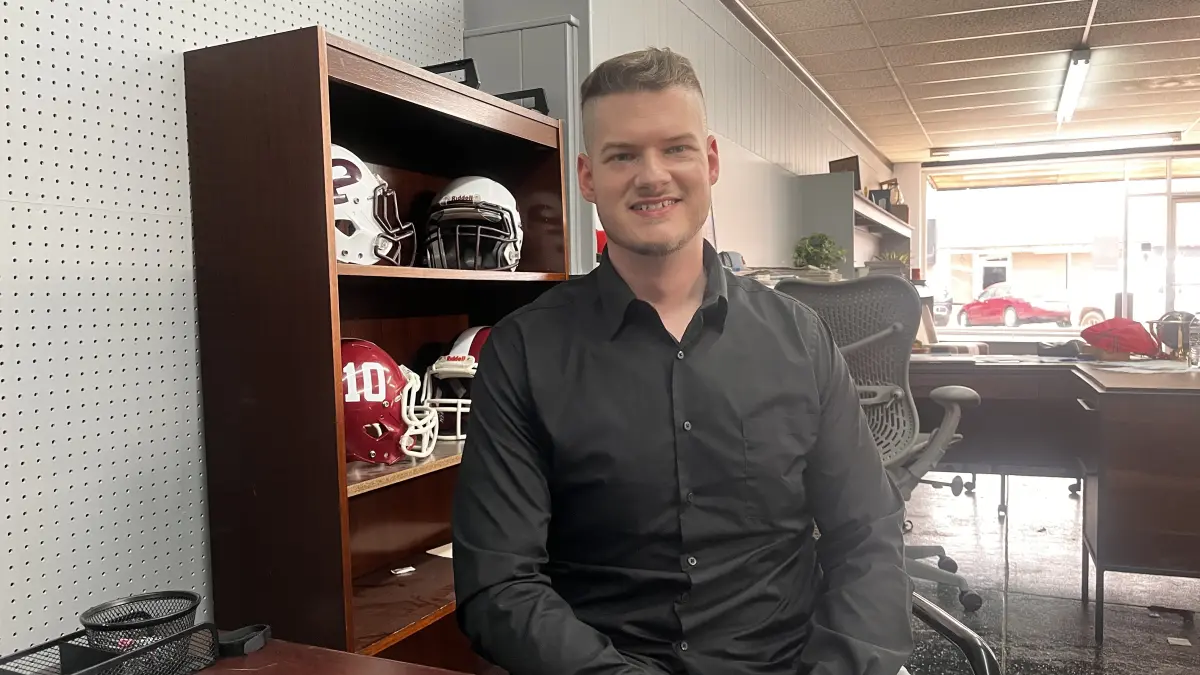
For Dr. James Miller, the strongest argument for supporting the proposed three-quarter cent sales tax for Southwest Arkansas Regional Medical Center begins with a simple reality: the hospital now belongs to the people it serves. He came by SWARK.Today's offices Friday afternoon.
Miller, a hospitalist and El Dorado native who has practiced at the Hope hospital since April of 2017, said the June 9th election is unlike previous efforts to support healthcare in the community because ownership of the facility has fundamentally changed.
"I think the biggest difference for me, or the selling point, or the pressure for me for the tax to pass is this is the first time that the hospital has been owned by the city and the county," Miller said. "It is your asset. [Not passing the tax] would be the equivalent of just like letting your courthouse become dilapidated."

The hospital is now owned by Hempstead County, after the Hope City Board opted to transfer ownership for the purpose of making it less complicated and quicker to place a 3/4-cent sales tax to support the hospital on the ballot. It is operated by Pafford Medical Systems.
"It's now the people’s," Miller said. "I think that's the biggest thing. [The tax is] not giving anybody operations money. It’s providing for your own asset when you need it, just like the roads that you drive on, police officers that serve you, firemen, everything. It's necessary now that the county owns it."
Miller believes the arrangement gives local residents more influence over the future of healthcare than they have enjoyed in many years. "It gives Hope and people of Hope a lot more control of what happens and who comes in, and what's done at the hospital," he said. "So, I think that this is the first time in decades, at least, when the people of Hope can influence what goes on, and if you're disgruntled with it, or if you're unhappy, or it's not providing the service, I think there's a lot more ability to change that."

As discussions have centered on the use of tax proceeds, Miller emphasized that the proposal is designed to improve infrastructure and equipment that belong to the community itself.
"If you need a CT, for example, or you come in with chest pain, abdomen, whatever it is, it's your CT," he said. "I mean, that's how the people need to think about it, because it's their taxpayer money. It's their CT."
The physician said updated equipment could expand services and improve care while reducing the need for residents to travel elsewhere for tests and procedures. "There are a lot of services, simple services that people have to leave from Hope to go do," Miller said. "And it's not just inconvenience for them. Even if your doctor is in Texarkana, and you don't seek your primary care here, it's inconvenient to get your secondary test [out of town]."

While he described current equipment as still up to the task, he said advances in medicine have created opportunities for improvement. "The equipment is a little bit older, functional, and it works well, but we have new modalities, and to upgrade some of that stuff here could be the difference between getting you from here to somewhere else if you're truly sick, or being more specific with your diagnosis."
Miller also commented on the efforts by staff to work inside the building itself, which dates to the early days of it being referred to as Medical Park Hospital when it opened 43 years ago, where staff members continue working around maintenance issues that have accumulated through years of financial struggles by past operators. "We have been really blessed with the issues that need to be addressed at the hospital," he said. "The patients and the staff and everybody have just come together to make it work and to not cause disrupted care or to allow it to influence patient care and to respond quickly to those needs."
Still, he acknowledged the difficulties that deferred maintenance has created. "That's been a big burden on Pafford, who already stretched their generosity," he said.
Despite those challenges, Miller said the hospital's physicians, nurses and staff have continued delivering quality care to the region. He believes that maintaining and improving facilities is essential not only for patients but also for attracting healthcare professionals.
"I do think that attracting physicians here is very important, and it's already a difficult challenge," he said. "And if you don't have an environment where physicians want to practice, you can't attract good physicians."
The issue also pertains to emergency healthcare, Miller said, in which travelling to a more distant facility does not lead to the best outcomes. "Even if you don't want to see your physician here for primary care, the hospital really is important for injuries, unexpected life events."

Residents deserve providers who are invested in Hope and Hempstead County, he added. "You want good talent there, and not only do you want good talent, you want people that care about the community. You don't want to be seen by somebody, and you feel like a number. You want to be treated appropriately, and so we want to attract the right people."
Miller believes the consequences of losing the hospital would be severe and potentially irreversible. "Sometimes I don't think people know the full implications [of a closure], and of course, once it closes, there's no going back."
Reopening a hospital after closure is far more difficult than preserving one that already exists, he said. "Your only option would be to convince a health system to do it," Miller said. "And then, how do you get the money, because they're still going to require the community to support that."

For that reason, he sees local action now as the most practical course. "I feel like it would be way better to be proactive," he said, "and to preserve the care. It's going to be cheaper. It's cheaper for the people."
Miller has watched the hospital through an ownership change from Steward Health Care and believes the facility's outlook improved significantly when Pafford Medical Systems assumed operations in 2024. "I think there's a feeling of relief to have someone that might pay attention and be more efficient, cut the waste, make this work," he said.
Under previous ownership, he said, local concerns often felt secondary. "When a big corporation owns hundreds of hospitals, they don't care about Hope or the people of Hope," Miller said. "If anything, it was a burden to have this hospital on their books."
The arrival of Pafford represented a different approach. Miller also noted that the company stepped forward when few others were willing to do so. "We had someone that purchased that was able to take over the operations of it, and then they did it, they put their money where their mouth is, so to speak, for the community when nobody else would or could."
He called that commitment "extremely generous." The changes since the Pafford Medical Systems takeover has also been evident among physicians and other healthcare workers, he said. "There's been a huge change in attitude and thought process from before and after Pafford's involvement in the operations of the hospital."
From his perspective, the hospital’s personnel have become stronger and more focused. "I think that from a medical staff perspective, from the physicians, we have people that want to be there, we have great doctors, we've weeded it, we've become efficient, and we've cut the fat."

Ultimately, Miller sees the tax proposal as an investment in something residents already own and depend upon. "It is to the asset that you own," he said. "It's the investment in that fire station or the police department that you pay taxes for. It's the investment in those roads to fix the potholes."
For Miller, the issue comes down to preserving a resource that serves Hope, Hempstead County and surrounding communities every day. "If the people of Hope want the hospital to stay," he said, "I think that you can have great providers there that are going to stay."