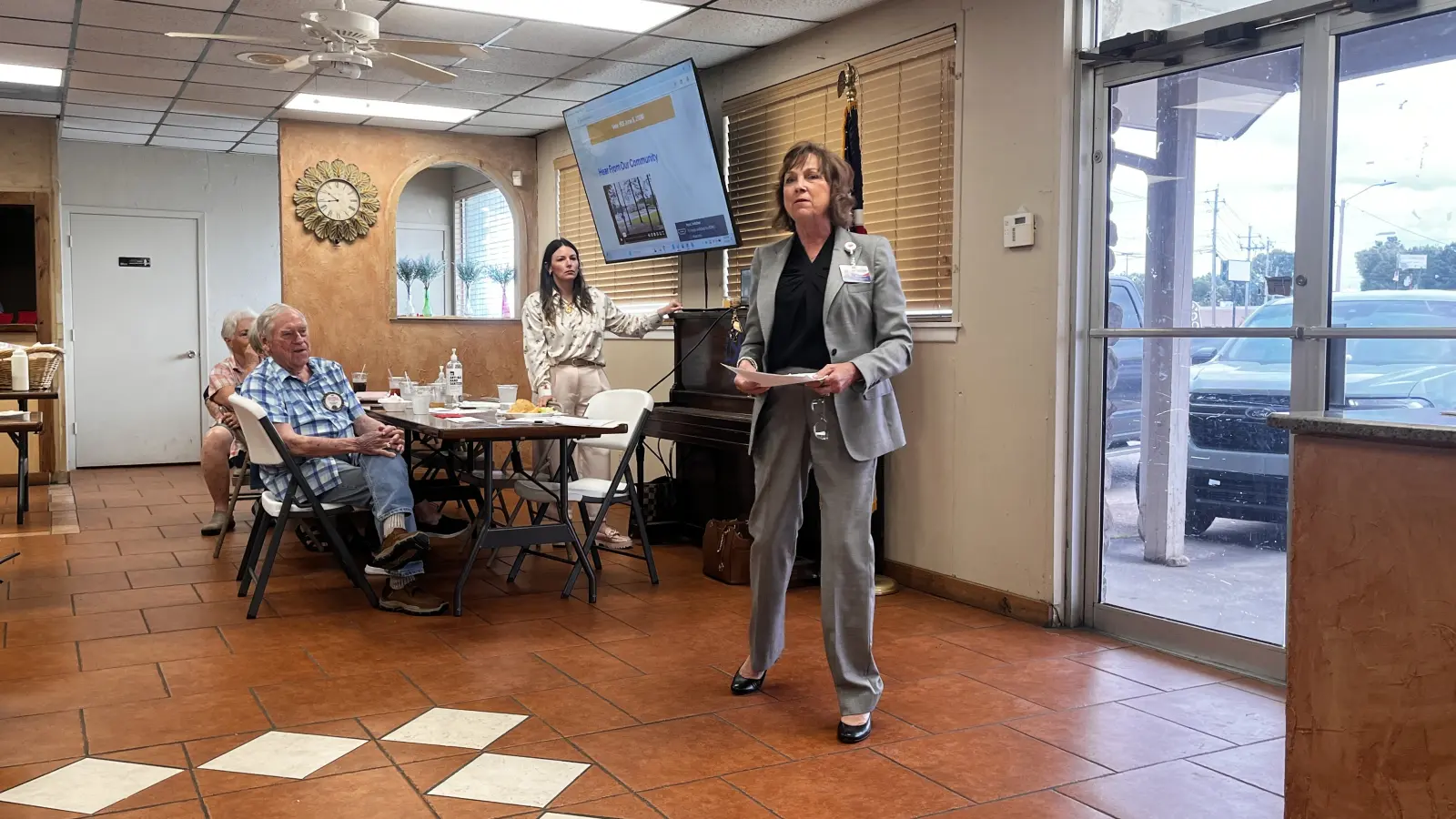



Appeals to support a proposed three-quarter cent sales and use tax to help secure the future of Hempstead County's only hospital led off a presentation Monday before the Hope Lions Club as Southwest Arkansas Regional Medical Center administrator Shelby Brown and Hempstead County Economic Development Corporation President Anna Powell argued passage of the measure, which is on the June 9th ballot, is essential to maintaining healthcare, industry and economic stability in Hempstead County.
Speaking to the Lions Club membership, Brown and Powell repeatedly emphasized the proposed tax would not fund day-to-day operations of the hospital and would instead be restricted to infrastructure, technology and facility improvements of the building owned by Hempstead County. A video presentation shown during the meeting described the issue as being “about our families, our neighbors, our future,” adding that “a small investment through the sales tax is needed to help secure the future of your hospital.”

Brown said the proposed tax would expire after 10 years and would not apply to fuel sales. Brown said it “will not only be paid by citizens, but everybody that’s traveling through Hope.”
Brown contrasted the proposal with the Hope Schools millage tax, which narrowly failed this past March. “This is different,” she said. “I do not live here. I live in Texarkana, but I shop here. This is the Walmart I typically use.”
By way of explaining that Brown's shopping habits are quite typical, Powell added that although Hope’s population is about 10,000, approximately 27,000 people move through the city and county daily.
The two women also addressed criticisms they said have circulated publicly about the tax and about the role of Pafford Medical Services in operating the hospital. After an audience member remarked that many citizens believe that if the tax is approved, “all the citizens of Hempstead County are going to give the Paffords money,” Powell responded that “there’s been zero dollars come from that hospital and given to the Paffords” and said the proposed revenues are legally restricted. “None of this money is going to operations. You can see it in the bond issue. Zero dollars can go to operations from the tax. It’s for infrastructure for the hospital.”

Brown said Jamie Pafford-Gresham personally intervened to preserve the hospital after bankruptcy proceedings involving previous owner Steward Healthcare. “When all those hospitals went on the market to sell, there was no one that was interested in buying this hospital in Hope, Arkansas,” Brown said. “Jamie Pafford personally decided how important it was to keep this hospital open for this community, and she put forth her own personal money for the hospital.”
Later in the meeting, Brown said, “Jamie stood up $9 million.”
Brown reviewed the complicated transition process that followed Pafford’s takeover of operations Sept. 19, 2024, after Steward Healthcare’s bankruptcy filing in May 2024. “Everything had to start from the ground up,” Brown said. “The electronic medical system, the phone system, all the contracts, everything had to start from the ground up.”

She said the hospital faced months without reimbursement payments while federal approval processes were completed. “The first bill did not drop until mid-December [of 2025], because Centers for Medicare and Medicaid Services did not approve the change of ownership until then,” Brown said.
Hospital leadership then pursued designation as a critical access hospital, a move Brown said would improve reimbursement rates and permit operation of swing beds for rehabilitation and skilled nursing care. Brown called it “a strategic move” because “it is going to create a little bit more revenue with a different revenue source.”
Brown also said the hospital has reduced staffing and restructured operations in an effort to improve efficiency, noting the hospital had “probably a little less than 150 employees full time” when Pafford assumed operations and is now “down to probably 105.”

Brown said that as part of a new initiative that is offering grants, the state has demanded evidence rural hospitals are transforming operations before awarding healthcare funding tied to federal programs. “The governor’s office wants to see how you’re transforming how you provide that rural health care,” Brown said.
She described efforts involving increasing cooperation among hospitals in Camden, De Queen, Howard County, Little River County and Mena on staffing, telemedicine and grant applications.
Brown said the hospital’s emergency room remains central to healthcare delivery in Hempstead County. Brown said the hospital saw 9,400 emergency room patients during the past year and asked, “Where do those 9,400 people go if they can’t get to the hospital?”
She said the hospital’s role is stabilization and transport: “If you come to us and you think you’re having a heart attack and you think you’re having a stroke, we have the knowledge and the skills to stabilize you and get you to a hospital that can care for you,” Brown said.

Powell approached the issue from an economic development standpoint, arguing the hospital is directly tied to industrial recruitment and retention. Saying “about 60 to 70 percent of the jobs in Hope are associated directly with industry,” Powell noted industrial prospects routinely ask about proximity to emergency healthcare facilities, calling it “one of the singular deciding factors" in whether they will locate here or remain here.
Powell warned that losing the hospital could trigger broader economic decline. “What happens to a community if it loses its hospital?” she asked. “You slowly see what I call a drain, a body drain, a capital drain, an investment drain.”
She pointed to nearly $200 million in industrial reinvestment tracked locally during the past three years. “Our industries like doing business here.” She also tied local ambulance availability to the presence of the hospital. “If we can’t do those things, then we are creating an opportunity cost for ourselves in our community,” Powell said.

A Lion member who works as a first responder, said ambulance delays outside the county could increase if the hospital closed, saying ambulances could be “out in St. Michael’s waiting an hour to drop off a patient.”
Audience members also questioned why rural healthcare funding discussed nationally has not reached Hope. Powell said local leaders have repeatedly pursued grants and state assistance and added, “We have been expecting the governor to give us money since we asked for it, and we have received zero.”
She said local leaders “can’t wait on somebody else to come and save us.”
“It’s what we get to decide, what kind of community we want,” Powell said. She made clear, too, that a showing of support for the hospital in the June 9th election may make grantors more likely to invest in the hospital in turn.

Questions also arose concerning Arkansas' reimbursement rates compared to those of Texas. Powell said “Texas reaps a 30 percent higher reimbursement rate on Medicare, Medicaid and commercial insurance on average,” while Brown explained that “Medicare reimburses based on medical costs in respective regions. "And we’re a poor region.”
As the meeting concluded, both speakers urged community members to share accurate information publicly before the June 9 special election. Brown told supporters, “When you hear someone say [something untrue], you correct them.”
Powell urged supporters to keep the focus on preserving healthcare access rather than personalities involved in operating the facility, saying, “We need to defend the lives that have to be saved at the hospital. I hope life is worth more to them than 75 cents per hundred dollars."