

With early voting underway and only three days remaining before Hempstead County voters decide the fate of a proposed three-quarter cent sales tax for Southwest Arkansas Regional Medical Center, community leaders gathered at the University of Arkansas Hope-Texarkana's Rapert Hall Auditorium with a simple message: the county's only hospital needs help now.
The tax is expected to raise $3 million a year or $30 million prior to when it sunsets ten years from now. It would be charged on purchases at the point of sale except for fuel. The hospital's marketing staff has provided an information page with more specifics.
Throughout the public meeting, hospital officials, elected leaders and an economic development president repeatedly stressed that the June 9th election is about more than a building. They argued it is about preserving emergency healthcare, protecting economic development opportunities and ensuring the long-term viability of the county's only hospital.

A video shown during one of the meetings framed the issue in stark terms.
"For generations, it has been here quietly waiting for the moment someone needs help, but today the future of health care in Hempstead County is not guaranteed, and now your hospital needs you," the narration stated. "On June 9, vote yes to keep critical care close to home, because when every second counts, distance shouldn't decide outcomes."
Mayor Don Still emphasized that the proposed tax would not be used to operate the hospital or pay employees. "I think one thing needs to be understood," Still said. "The sales tax is for the building and grounds and equipment. It's not going for payroll or anything to do with the running of the hospital. It's going to update the roof, the AC, and some equipment inside, so the tax is going to be used locally, and it's going to stay with the hospital."

The strongest appeals came from Pafford Medical Services CEO Jamie Pafford-Gresham, whose family stepped in to keep the hospital operating after its previous owner, Steward Health entered bankruptcy. Pafford-Gresham said the facility's future depends upon creating a stable source of funding for infrastructure and equipment.
"We've been managing this emergency," she said. "We're very thankful for the partnerships that we have with Hope and Hempstead County and Hope Water and Light. If the air conditioner doesn't work, the lab shuts down, that affects health care all the way around, and we can't tell you what's wrong with you in the ER."
She repeatedly returned to the theme that the election is ultimately about community responsibility. "None of us like a new tax. None of us want to be taxed," Pafford-Gresham told attendees. "But we thought through this as a group and said, well, what's the best way to do it?"

Later, she became even more direct. "We can all moan and groan and complain about a tax, but at the end of the day, it doesn't matter to you until it's one of your family members or your neighbor that needs [the hospital]," she said. "And then you get really upset because it wasn't there, and then I'm going to say it's your fault, because it's your fault if you can't figure out that we've got to step up and take care of each other."
Pafford-Gresham urged supporters not only to vote but to persuade others to do the same. "I would just encourage everyone, really go out and grab your family and go. We need to go vote for this. This is something we need."

Hospital Administrator Shelby Brown argued that local healthcare is performing exactly the role rural hospitals are intended to play. "We are a small rural hospital, and our job is to be there in emergency situations for your son or for anyone else who has something happen unexpectedly," Brown said.
In answer to an audience-member question about the need to make sure hospital staff are paid, Brown said the tax would indirectly help hospital operations by relieving the burden of major capital expenses. "When we free some of our budget up for maintenance, that gives us more money in our operating budget to be able to ensure that we are making the vendor payments and the other things that the day-to-day operations of the hospital requires.”

On the subject of what the hospital's leadership has done to increase its income, Brown pointed to the decision to seek critical care facility status, which meant some changes of emphasis for the facility that reduced the number of beds but complied with a number of federal requirements so that the hospital coul charge Medicare 101 percent of the costs of providing care for Medicare recipients. This increase does help the bottom line, but it took a lot of time to become eligible for, time when the hospital lost more money each month than it does now.
Justice of the Peace Ed Darling warned that the county faces a critical moment. "Only in the next five years, 40 percent of the rural hospitals in Arkansas are closing," Darling said. "I think this sales tax position puts us in a position where we won't be in that 40 percent."

Darling also stressed that the hospital's operating partner and local government would have separate responsibilities moving forward. "The city and the county is responsible for the building and facility," he said, while operators would remain responsible for day-to-day costs and personnel.
Hempstead County Economic Development Corporation President Anna Powell argued that the hospital's importance extends well beyond healthcare. "If you want to attract a hospital that has experience in operating a brand that's much larger, or that specializes in rural health care spaces, a tax is what those organizations are looking for," Powell said.
She also warned that losing the hospital could hurt efforts to recruit and retain employers. "One of the first questions that's always on those forms--it doesn't matter what type of company or industry it is--it's always where's your local hospital," Powell said, referring to when companies considering locating here send questionnaires to her office. "There is an opportunity cost for them if we lose our hospital."

Powell pointed to major economic opportunities developing across southwest Arkansas, including lithium projects and defense-related growth near Camden, saying quality-of-life assets such as healthcare will influence where workers choose to live. "There is so much good happening in southwest Arkansas," Powell said, "and if we can capitalize on it, we can truly become a growth community."
As the meeting concluded, the speakers returned repeatedly to the same message: outside funding from the federal government and the state has not materialized, major infrastructure needs remain unresolved, and local voters will decide whether the community invests in the hospital's future.
"We've asked for money, we have begged for money, we have filled out all kinds of paperwork," Pafford-Gresham said. "We're kind of at the end of our rope at this point in time."

For the coalition assembled at UAHT, the June 9 vote represents more than a tax proposal. In their view, it is a decision about whether Hempstead County will take responsibility for preserving local healthcare before another rural Arkansas hospital becomes a casualty of the state's ongoing healthcare crisis. For them, the price of 3/4 of a cent for every dollar spent in the county is not too great a cost for keeping our hospital.
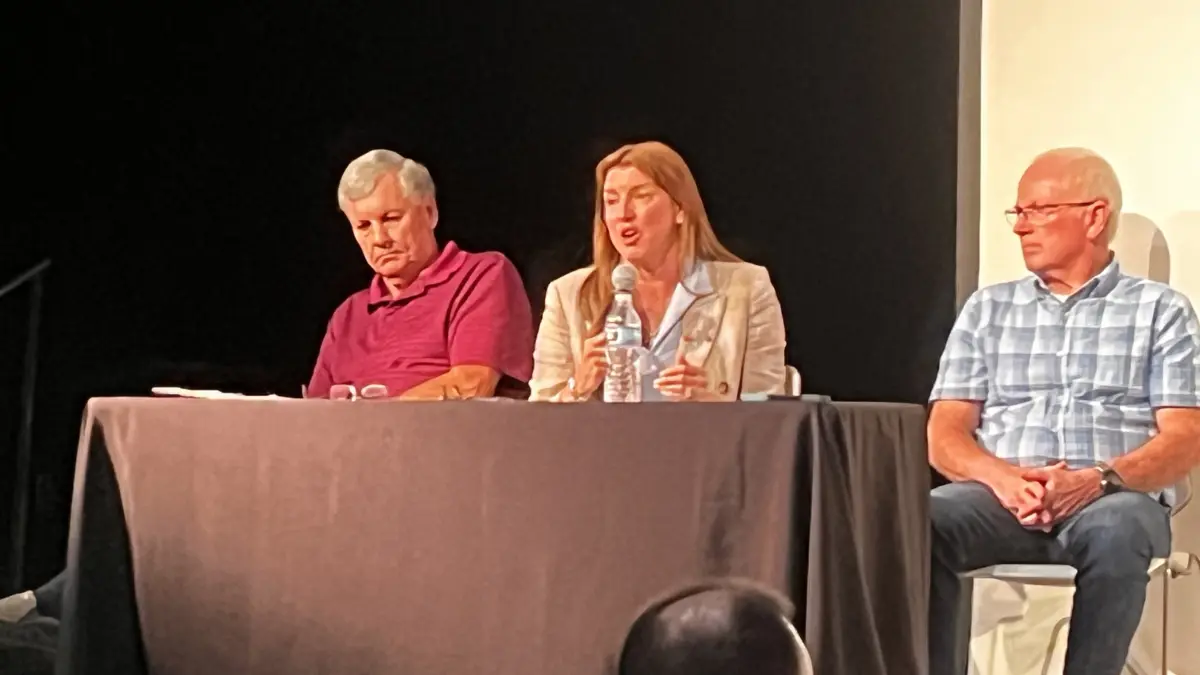
Above photo: Pafford Medical Systems CEO Jamie Pafford-Gresham speaks as (left) JP Ed Darling and (right) Mayor Don Still look on at Thursday evening's forum on the hospital tax at UAHT's Rapert Hall Auditorium.