
As a salute to the contributions made by nurses in Hempstead and Nevada Counties, swark.today is continuing its series of profiles, begun Wednesday, of several nurses who serve patients here.
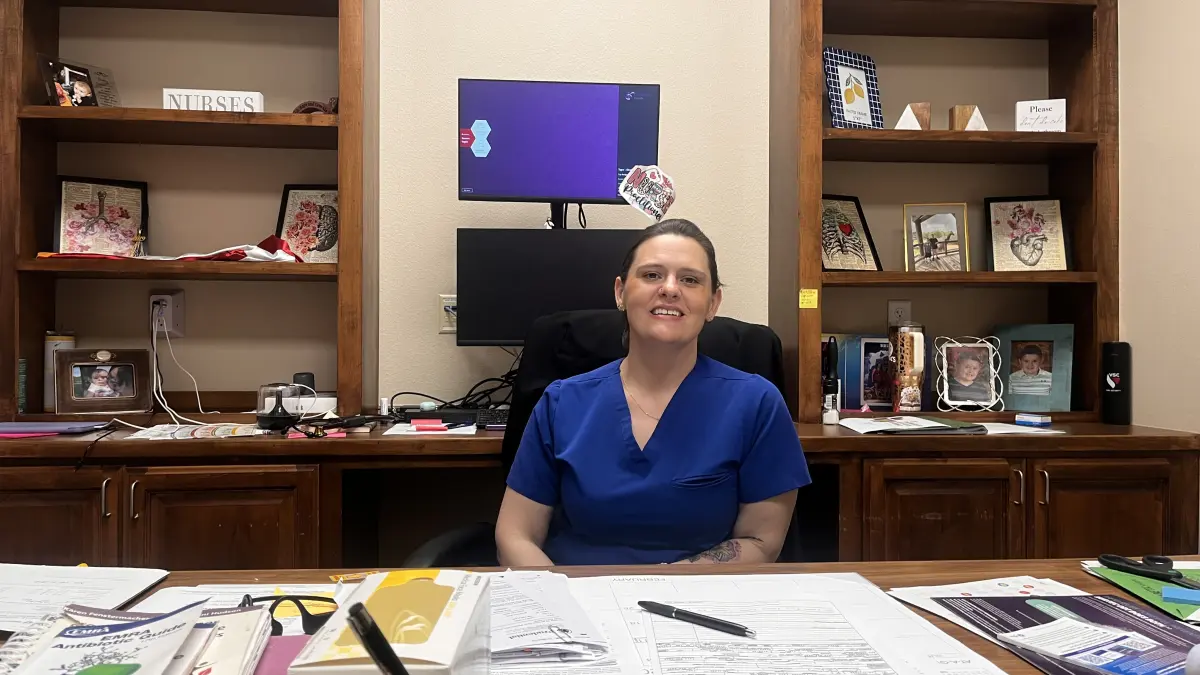
After a long and busy Monday at the Christus Trinity Clinic in Hope, nurse practitioner Emma Stewart finally had a few moments to sit behind her desk and reflect on a healthcare system in southwest Arkansas that has changed dramatically since she first entered nursing school.
The pace of the day had already told part of the story.
“There are times like today that the two other nurse practitioners and I didn’t have any openings on our schedules. We were full,” Stewart said. “And that’s with other clinics in town. So I can only imagine, in rural areas where there is one clinic for the entire town, how busy they stay.”

The strain, she said, comes from a reality now familiar to many small Arkansas communities: fewer doctors, fewer clinics and now hospitals fighting simply to stay alive. “We used to have probably, what six family practice clinics in town,” she said. “Now we’re down to Three or four?”
Stewart has watched that transformation unfold from close range because nearly every stage of her own life and career has been rooted in Hempstead County and the surrounding area. Raised in Spring Hill and a graduate of Spring Hill High, Stewart originally intended to pursue pharmacy school at Southern Arkansas University before a local opportunity altered the direction of her career.
At the time, the University of Arkansas for Medical Sciences had its BSN nursing program on the Hope campus. “I started working towards that in 2004,” Stewart said. “I went to college right out there, the first two years for my associate’s degree, and then got my bachelor’s through the connection with UAMS right there. I love that I didn’t have to go far off.”

While still in school, she began working at what became Southwest Arkansas Regional Medical Center as a telemetry technician in the ICU.
After becoming a registered nurse, Stewart worked in intensive care, emergency services and as a house supervisor. Along the way she worked beside familiar local names in healthcare and developed the broad experience she now says was essential preparation for becoming a nurse practitioner. “I highly recommend becoming an RN first,” she said. “Without the experience, this job would not be near as smooth sailing as it is.”
Her career later expanded into education when she joined the nursing faculty at University of Arkansas Hope Texarkana, the college then known as UACCH. “I taught for five years,” Stewart said. “I taught LPN and RN students.”

Teaching eventually paid pretty visible dividends as former students began appearing around her professionally. “As a matter of fact, Lisa, my nurse, I taught one of her classes,” Stewart said. “And then Jessica, I taught her when she was an LPN,” Stewart continued. “Then I taught her for her RN, and then I got to have her as a student nurse practitioner.”
That same commitment to mentoring still shapes her work today.
“If I ever have any hope of retirement, I’ve got to make sure there’s another generation to come behind me,” she said with a laugh.
Stewart herself returned to graduate school in 2014 when her oldest son was just a year old. She completed nurse practitioner training in 2018 and entered her first NP position the following year.

Her work carried her through clinics in Prescott and Hope before she joined Christus Trinity Clinic, where she has now spent more than two years. “I’ve been a nurse practitioner for seven years and an RN for 18,” she said. “It’s hard to believe that it’s been 18 years.”
The long hours and years of preparation, she said, were always driven by one central purpose: the need for healthcare in rural Arkansas.
“This area is so underserved for healthcare,” Stewart said. “And I see it not only in the Hope area, but you’re looking at Spring Hill, you’re looking at Lafayette County, you’re looking at Nevada County where there are just not a lot of options for healthcare.”
“And if rural areas don’t have nurse practitioners or other providers besides MDs,” she said, “our gap for healthcare becomes very, very wide.”

That reality becomes apparent every day inside the clinic.
Stewart generally arrives by 8:00 a.m., reviews overnight lab work and refill requests, studies the day’s schedule and begins seeing patients by around 8:15 or 8:30. A normal day may bring 20 patients. Heavy days can exceed 25.
The work ranges from chronic disease management to medical emergencies. “We’ve had patients have seizures in the rooms,” Stewart said. “We have had patients pass out in the rooms.”
Then there are the unexpected rural injuries. “We had one that he’d been hog hunting,” she recalled. “Hog got his arm cut open. He wanted me to sew it. I said, ‘Man, you need some scans. Hang out here. We’ll get you to the hospital.’”
Though the clinic handles a broad range of medical issues, Stewart said modern healthcare technology has transformed what rural providers can accomplish. “The imaging quality that we have now even compared to 10 years ago, it is unreal,” she said.

Telehealth and digital imaging review have also dramatically shortened diagnosis times.
“We have these groups that we send our X-rays and our MRIs to, and they read it, and we have the results back in 24 hours,” Stewart said. “Whereas it used to take days to get those back.”
She points especially to advances in cancer care. “The oncology realm is one that has seen great advancements over the years,” Stewart said. “They get you in a lot faster. The imaging is faster, and the diagnosis is done a lot quicker.”
“That’s why we’re seeing such more successful cure rates on a lot of things,” she said, “because we catch it earlier.”
Still, Stewart believes no amount of technology can fully compensate for the disappearance of rural hospitals. “Hospitals play a role in small communities,” she said, pointing to nearby Prescott as an example of what can happen when a hospital is closed. “They used to be a booming little town.”
She also tied healthcare directly to economic development in communities such as Hope.
“In these small towns, we rely on the industry that we have here, but the industry requires that we have a hospital,” she said. “So losing a hospital is detrimental not just to the health of the area, but the industry in the area, too.”
This is something to keep in mind with a 3/4-cent sales tax about to be on the June 9th ballot for Hempstead County voters that would help provide funds to repair the roof of Southwest Arkansas Regional Medical Center and upgrade its equipment. Two years of efforts to seek funds for these projects from the state of Arkansas in the form of grants have been unsuccessful.
For Stewart, these concerns are not abstract policy debates. They affect the people she treats. “These are people I went to high school with,” she said. “These are people who my grandparents were friends with.”
Her roots in the community run deep. Her mother taught school at Spring Hill. Her grandmother Elaine owned a business in Hope called Elaine’s Final Touch. Her grandfather raised cattle. Stewart and her husband now operate a six-house poultry farm near Spring Hill while raising their two sons.
“When you are from the area, people tend to trust you,” she said. “They tell me things maybe they wouldn’t feel comfortable talking to someone that they don’t know.” That personal trust, she said, as well as helping with diagnoses, often becomes one of the most rewarding parts of practicing family medicine.
“I’ve had several new onset diabetics that we worked with really hard, and over the last year we’ve got their blood glucose under control, and they’re doing great, and they’ve lost weight, and they feel better,” Stewart said. “I love seeing it.”
“I can write the prescriptions all day long,” she added, “but unless you put in the work as a patient and you want it, medicine can only do so much.”
Meanwhile, the practice of healthcare, she said, demands sacrifice and constant learning. “It is not an easy job,” Stewart said. “It’s a lot of hard work.”
“You never quit learning,” she said. “Every day I learn something new.”
But after nearly two decades in nursing, she still believes the rewards outweigh the strain and is unhesitant about recommending the profession to young people, who she still enjoys helping to train.
“It’s not an easy road,” Stewart said, “but it is a very rewarding road.”
“With this job,” she said, “at least when it’s stressful and you’re tired, you do get to see your outcomes and what you put into the world.”