


The nation's effort to develop the vast lithium reserves beneath the Smackover Formation, which comes through Texas, Arkansas and Louisiana, will not be complete simply by producing lithium carbonate in South Arkansas. The next, and perhaps most important, step will be creating the capacity to manufacture cathodes, the battery components that use lithium, rather than sending locally-produced lithium overseas for additional processing.
Representatives of three companies investing in the Smackover agreed Wednesday that developing those downstream industries in the United States, and ideally in the Ark-La-Tex or the surrounding region, will determine whether America truly establishes a domestic battery supply chain or continues relying on foreign manufacturers to complete the work.
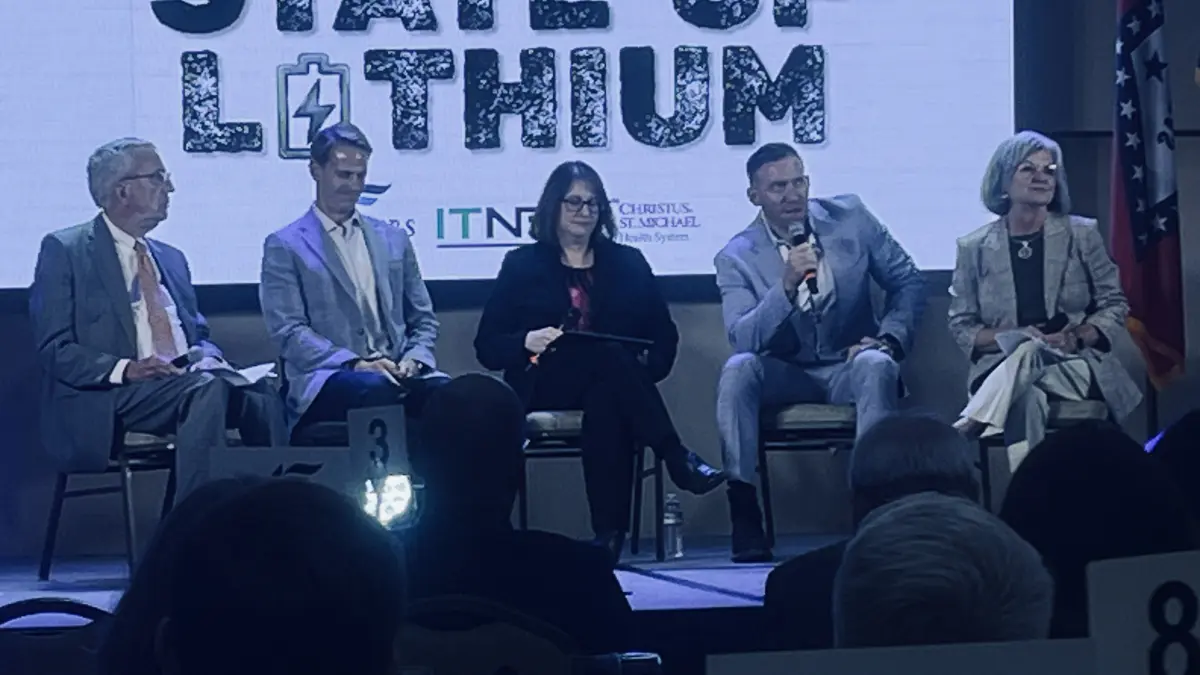
That consensus emerged during the second panel discussion of the Texarkana USA Chamber of Commerce's State of Lithium Summit, held Wednesday around midday. Robin Hickerson, president and CEO of the Texarkana USA Chamber of Commerce, moderated the discussion with Teague Egan, founder and CEO of EnergyX; Jennifer Wilding, general manager of Asset Development for Chevron New Energies; Matthew McCowan, U.S. Lithium Manager for ExxonMobil; and Randy Zook, president of the Arkansas State Chamber of Commerce and Associated Industries of Arkansas.

The next step after lithium production
While public attention has focused on extracting lithium-rich brine from beneath the Smackover Formation, McCowan said the industry cannot stop once lithium brine has been extracted. ExxonMobil intends to build facilities capable of carrying the process to that point, but another critical manufacturing step is largely absent from the United States today. "Our intention is to build a facility that takes the lithium-containing brine and makes that lithium carbonate product," he said.
The challenge, McCowan said, is finding customers that can convert lithium carbonate into cathode active material. "Right now the customer base to take that carbonate product and turn it into a cathode active material is non-existent in the United States," he said. "That's a problem." Without those facilities, he said, lithium produced in the region would largely have to continue its journey overseas for the next stage of manufacturing.

Today, he said, those additional processing capabilities are found primarily in China, South Korea and Japan. Arkansas leaders, however, are already considering how to attract cathode manufacturing to the state or at least somewhere within the region. For companies investing in the Smackover, McCowan said one of the strongest market signals would be evidence that the energy industry intends to build the rest of the battery supply chain alongside lithium production.
Egan said the supply chain stretches even farther than cathode manufacturing. Lithium becomes part of a cathode, which then becomes part of a battery cell before reaching electric vehicle manufacturers, grid-scale energy storage systems and other users. As battery production has accelerated, he said, manufacturers have increasingly moved upstream in an effort to secure dependable lithium supplies before competitors do. "There are a lot of customers for this that are trying to buy lithium," he said.

Why the Smackover Formation attracted worldwide attention
Asked why companies with global operations selected South Arkansas and East Texas in which to do their mining, the panelists agreed that the answer begins underground. Egan said lithium companies do not choose where to locate in the same way other manufacturers do. "We don't really decide where the business is located," he said. "Planet Earth decides where the lithium is."
The Smackover Formation, he said, is "one of, if not the best, lithium deposits in the United States," containing millions of tons of the mineral beneath Arkansas and East Texas. EnergyX has leased acreage on both sides of the state line and intends to recover that resource for domestic manufacturing. "That's what EnergyX is looking to extract," he said.

McCowan said ExxonMobil reached much the same conclusion after studying lithium opportunities around the world. The quality of the Smackover resource drew the company's attention, but so did the industrial foundation that already exists in Arkansas and Texas. Oil and gas production, bromine extraction and decades of regulatory experience mean much of the infrastructure needed for a lithium industry is already in place.
"The resource, the lithium concentration, the rock quality were spectacular," McCowan said. Just as important, he said, state regulators have worked with industry to adapt existing rules to lithium production. The leadership of the Arkansas Oil and Gas Commission and the Texas Railroad Commission, he said, "has been just incredibly helpful and wonderful to work with as we think about moving forward with this business."
Wilding said Chevron reached similar conclusions after examining future demand for lithium around the world. With energy consumption continuing to rise and demand for battery materials expected to grow with it, she said, the Smackover Formation represents a long-term opportunity that fits the company's strategy. "It was a good investment for Chevron to be in this space," she said.
Building a new industry from the ground up
The panelists emphasized that developing the Smackover Formation adapts existing oilfield practices to produce lithium but goes some steps further. Much of the industry's success depends upon refining direct lithium extraction, or DLE, technology but also on simultaneously building the manufacturing network needed to support it. For that reason, they said, companies are not simply opening mines; they are helping create an entirely new industrial sector.

Egan said direct lithium extraction remains in its infancy despite the excitement that has greeted it lately. "We're really pioneering this industry," he said. Although a handful of commercial facilities are operating overseas, he noted that only recently have large-scale DLE plants begun coming online, meaning much of the technology and the supply chain required to support it are still evolving.
That reality has forced companies such as EnergyX to devote years to designing and refining the specialized equipment needed to separate lithium from underground brine, including absorption columns, the materials that selectively capture lithium, chemical extraction systems and the refining processes required to convert raw brine into battery-grade products. "There is a huge supply chain that goes into making a DLE plant that doesn't exist on a commercial scale that has to become a reality," he said.

EnergyX itself has evolved alongside that technology. Egan said the company began as a technology developer hoping to license its extraction process to companies that owned lithium resources. Only later did it begin acquiring acreage and become a fully integrated lithium company. "We first initially started out purely focused on the technology," he said. "A few years ago, we got into fully vertically integrated focus." The company now has a demonstration facility in Hooks, Texas engaged in refining brine. If extensive testing finds the project feasible, a larger plant will be built at the same location.
Companies bringing different strengths
Although EnergyX, Chevron and ExxonMobil are pursuing the same resource, each panelist described a somewhat different approach to developing it. Their companies vary greatly in age and experience, but all said they expect to be involved in South Arkansas for decades rather than years.

McCowan said ExxonMobil entered the lithium business only after determining that the work closely matches capabilities the company has spent more than a century developing. The similarities to the oil and gas industry begin underground with geological analysis and drilling, but they continue above ground through chemical processing and large industrial facilities. "We've been doing that for over 100 years," he said.
He said ExxonMobil viewed two questions as essential before entering the business. First, could the company's existing expertise be applied to lithium production? Second, could the industry support projects large enough to justify long-term investment? The answer to both, he said, was yes. "We see this as a multi-decade, multi-project opportunity," McCowan said after noting the company's extensive lease holdings across the Smackover Formation.

The opportunity, however, depends upon remaining competitive with producers around the world. McCowan said lithium is traded internationally, making cost control critical. “These projects need to compete globally on the supply curve," he said. "It is a global commodity."
Wilding said Chevron likewise sees the Smackover as a long-term opportunity but is still in the earlier stages of evaluating its Arkansas acreage and determining how best to develop it. Even so, she said, the company is already examining the entire battery value chain while identifying opportunities to work alongside communities and other stakeholders as projects move forward.
"Partnership is a key value for us at Chevron," Wilding said. She explained that the company intends to engage local communities as projects advance, saying those relationships will be an important part of successfully developing the resource. As the company better understands the opportunities ahead, she said, it expects to identify additional areas where local businesses, governments and institutions can participate in the industry's growth.

Later in the discussion, Wilding said Chevron also sees lithium as an extension of its broader mission to provide affordable and increasingly cleaner sources of energy. The company's experience gives it confidence that it can help develop the Smackover while also contributing to workforce development and education, she said, but there is also confidence demand will increase.
"Our benchmark data indicates we expect four times the lithium demand in 2030 compared to 2022," Wilding said. That projected growth, she said, makes the Smackover Formation an especially attractive place to invest while building the workforce and technical expertise needed to support the industry's future.
Egan said EnergyX is equally focused on becoming part of the surrounding communities. He pointed to the company's public launch event earlier this year and invited summit participants to tour its demonstration plant about fifteen minutes from the ballroom hosting the event, saying the company wants area residents to understand what it is building and how the technology works. "We want that community interaction," he said.
The enthusiasm he has encountered in South Arkansas has reinforced the company's decision to invest here, Egan said. Referring to Gov. Sarah Huckabee Sanders' remarks that morning about preparing workers for lithium-related jobs, he said the region has embraced the possibilities of a new industry that could significantly increase incomes while creating careers close to home. "It's just a super exciting time to be in this region with this new industry that's growing and is super important to our economy and national defense," he said.
Building the infrastructure to support lithium
One challenge all three companies acknowledged is that a successful lithium industry will need enough energy capacity to power those facilities, and that is an issue developers already are considering as projects move from planning to construction.
Zook introduced the topic by describing a massive solar project announced in Mississippi County that will include substantial battery storage, noting how rapidly electricity demand is growing alongside the technologies that depend upon lithium. He then asked whether South Arkansas will have enough generating capacity to support a mature lithium industry several years from now.
Wilding said meeting rising energy demand is central to Chevron's overall business strategy. While the company continues producing oil and natural gas, she said, it also recognizes the need to develop new energy technologies such as lithium production. She described that work as maintaining a balanced energy portfolio capable of supplying the country's future needs.
McCowan made clear today's electrical system likely could not support multiple large lithium facilities without additional investment, but he emphasized that companies are planning projects over many years rather than all at once. That approach, he said, gives the concerned entities time to expand infrastructure together. "We need to be partnering with the state, with the local utility, to make sure that we're being thoughtful about growing that out for the long term," he said.

Egan agreed that additional generating capacity will be necessary. He said developers already are considering several possible solutions, including expanded transmission lines, solar generation, natural gas-fired facilities and even small modular nuclear reactors if that technology becomes commercially practical. Whatever solution emerges, he said, supplying enough electricity will be one of the industry's most important long-term challenges.
Preparing workers and local businesses
As the conversation turned toward economic development, the panelists agreed that preparing a workforce should begin well before the first commercial plants enter operation. Waiting until construction begins, they suggested, would leave companies competing for too few qualified employees.
McCowan compared the future lithium industry to the bromine industry that already operates in South Arkansas, saying the greatest economic impact will extend well beyond the workers employed directly by processing plants. Hotels, restaurants, contractors, equipment suppliers and numerous other businesses, he said, stand to benefit as construction and operations expand across the region.
He encouraged residents to learn about initiatives already being developed, including the state's Lithium Works program, saying education and retraining should begin now rather than after facilities are completed. "We need to grow a pretty significant, sizable workforce so that we can all win and we can grow out this industry," he said.
McCowan also encouraged existing businesses to begin preparing for opportunities in the lithium supply chain. ExxonMobil maintains an online supplier portal where companies can introduce themselves and describe the products or services they provide. Whether those businesses specialize in construction, maintenance, transportation or other support services, he said, establishing relationships now will improve their chances of participating as projects advance.
Egan illustrated those opportunities by describing the construction of EnergyX's demonstration plant in nearby Hooks. Although the facility itself will employ about 40 people while operating around the clock during its testing phase, he said local contractors already have played significant roles in constructing it. Regional companies handled building improvements, piping and instrumentation, while drilling operations created additional work for crews familiar with oilfield operations.
Those numbers increase dramatically at commercial scale. Egan said EnergyX estimates that an envisioned 50,000-ton commercial lithium plant would create approximately 300 direct jobs while supporting roughly 3,000 additional construction and indirect jobs. Those estimates, he said, reflect not only employment at the plant itself but also the contractors, suppliers and service companies needed to build and operate such a facility.
Wilding said Chevron likewise has begun building relationships with local universities, trade organizations, government agencies and communities while evaluating its Arkansas acreage. Although she described the company's work as still being in its early stages, she said developing those partnerships now will help position the region for long-term success as projects move forward.
A vision extending beyond lithium production
Asked to describe what the region might look like a decade or two from now, the panelists envisioned an industry that reaches well beyond extracting lithium from underground brine.

Wilding said today's work evaluating resources, technology and partnerships is intended to create the foundation for projects capable of expanding for many years. Understanding the resource thoroughly during these early stages, she said, will set up both the industry and surrounding communities for long-term growth while helping meet rising worldwide energy demand.
McCowan said he hopes direct lithium extraction eventually becomes as familiar to Arkansans as oil, gas or bromine production. Beyond that, he envisions an industry in which lithium mined from the Smackover Formation remains within the United States through each stage of manufacturing, supplying batteries for electric vehicles, artificial intelligence data centers, military applications and energy storage systems. "If we really get it right," he said, "that all stays local."
Egan said he believes the region's opportunity extends even further. Looking ahead to 2036, he predicted the Smackover could produce between 200,000 and 300,000 tons of lithium annually. Just as important, however, he said EnergyX hopes to attract industries that perform the manufacturing steps currently missing from the American supply chain.

He pointed to EnergyX's recently announced Battery Mecca USA initiative as one example. The company plans to build an additional 15,000-ton cathode plant adjacent to its lithium operation, bringing another segment of battery manufacturing to the region instead of exporting the material elsewhere for additional processing. Texarkana's central location among several battery-cell manufacturing plants under development also positions the area to become an important manufacturing hub, he said.
"I think this area has a lot more potential than just the lithium," Egan said. "It's on us and everybody here to make that vision a reality."
Hickerson closed the discussion by telling those attending that the industry's future is already taking shape in the Texarkana region. Encouraging the audience to continue learning about lithium development after the summit concluded, she invited businesses that are not already members of the chamber to become involved in future conversations as the industry continues to evolve.

"The future is not coming to Texarkana USA," Hickerson said. "The future is here."
Above photo: Members of the second panel discussion session at Wednesday's State of Lithium Summit in Texarkana's Hilton Garden ballroom included, from left, Randy Zook, president of the Arkansas State Chamber of Commerce and Associated Industries of Arkansas; Matthew McCowan, U.S. Lithium Manager for ExxonMobil; Jennifer Wilding, general manager of Asset Development for Chevron New Energies; Teague Egan, founder and CEO of EnergyX and Robin Hickerson, president and CEO of the Texarkana USA Regional Chamber of Commerce who was moderator.