


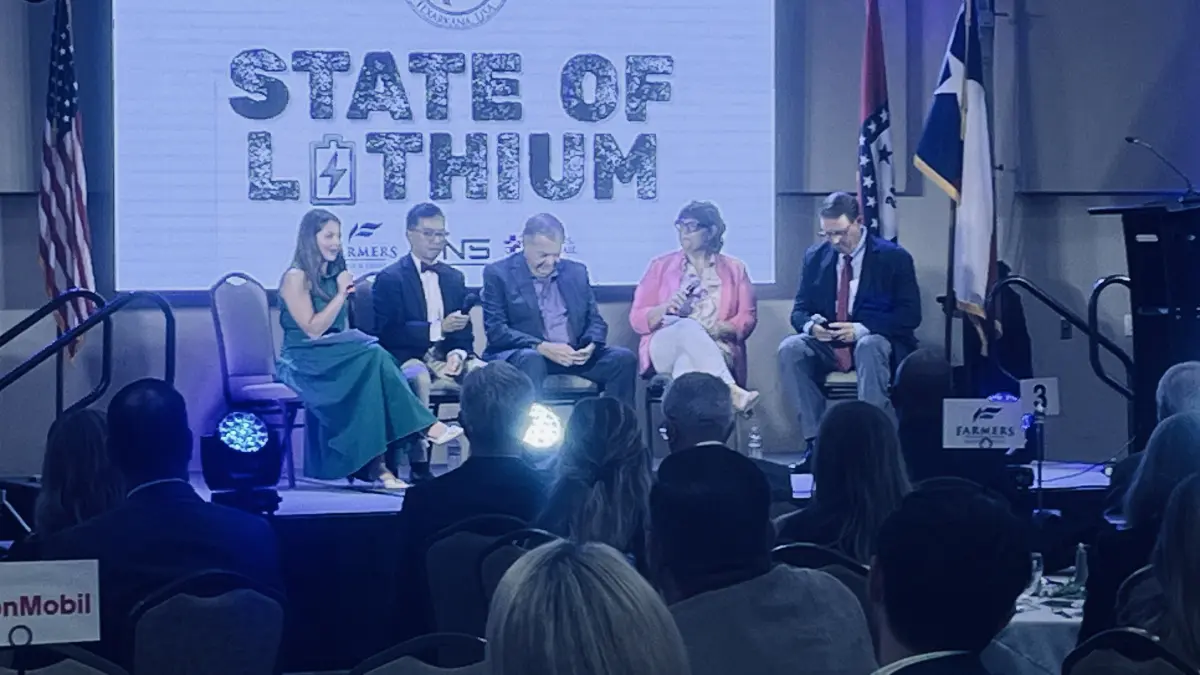
The region's opportunity to benefit from lithium production will depend on planning for long-term growth rather than chasing a short-lived boom and will involve making clear to residents they have little to fear from the environmental impact, panelists said Wednesday morning during the opening discussion of the Texarkana USA Chamber of Commerce's State of Lithium Summit.
Moderated by Texarkana Chamber of Commerce Director of Events and Communications Chloe Wardlaw and Executive Director and CEO of TexAmericas Center Scott Norton, the discussion featured Dana Poindexter, regional manager for community development with the Arkansas Economic Development Commission;; Arthur Orduña, executive director of the Venture Center in Little Rock; and John Burba, chief technology officer for International Battery Metals.
Wardlaw opened by asking the panel to explain the Smackover Formation and why it has become the focus of intense interest across Southwest Arkansas and neighboring areas.
Burba described the geological facts of the formation. "It spreads across essentially all the way across the southern United States," Burba said. "Areas of that formation contain significant concentrations of lithium. Lithium is extractable because it's in very high concentration of brine water, and so the areas that we know that have significant lithium concentrations are Arkansas and North Texas."
Poindexter said the lithium itself is not a new discovery. "Lithium's always been here. That's not new," she said. "What's new is the technology. And the ability to access it in an environmentally responsible way."
Norton explained that the industry's current momentum has been built on decades of experience extracting bromine from the same underground brines.
"This new wave is being built literally on top of almost 40, 50, maybe even 60 years worth of brine work," Norton said. Companies including Lanxess and Albemarle, he said, have already created jobs and infrastructure throughout South Arkansas, providing a foundation for lithium development to expand into additional counties.

Asked whether the region is witnessing a once-in-a-generation economic opportunity similar to past oil booms, Poindexter answered simply, "Yes," before explaining that she preferred a different way of describing the industry's future.
"We're not chasing a boom here," she said. "We have new industry, new technology, and there's nothing about either one of those things that says, 'Hey, we should move really fast.'"
Instead, she said, the emphasis should be on "creating a sustainable industry that can support our communities for decades to come."
Poindexter said conversations with communities in Columbia, Lafayette and Union counties have been underway for more than three years as residents learn about the emerging industry. During that time, she said, local priorities have remained remarkably consistent.
"We're talking about housing and workforce and education, infrastructure challenges, and those have all been priorities," she said. "What the lithium industry has allowed is for these projects just to move forward a bit faster. So it's given some momentum, it's created some urgency, and it's created new investment."
Orduña agreed that the greatest opportunity extends beyond lithium production itself. "What it is is exactly what Dana said, which is it's a catalyst," he said. "It's catalytic to try to bring everybody together to create that kind of shared vision."
Rather than allowing companies alone to define success, Orduña encouraged communities to decide what they hope to become over the next several decades. "What should success look like in five years? What should it look like in 20?" he asked. "How would you describe your community as a result of lithium as a catalyst in 20 years?"
He said the industry's lasting success ultimately will be measured by the strength of the surrounding communities. "The true measure is going to be that it won't just be a successful lithium industry. It will be the success and the growth of our communities across the region."

Wardlaw then turned the discussion toward environmental concerns, noting that many residents have questions whenever new technology is introduced.
Orduña said the industry's direct lithium extraction process, commonly called DLE, avoids many of the environmental impacts associated with lithium mining in other countries.
"We don't have to dig huge, gigantic artificial lakes and ponds like they do in South America, and we don't have to create these really, really attractive, huge open pit mines like they do in Australia," he said. "We pull up brine, we extract, we put the brine back down."
He said the industry has been using similar techniques for bromine production in Arkansas for decades.
"The onus is on us to continue to not only do it well, but to do it even better." Infrastructure planning, he added, should begin before large-scale production starts.

"The hope is that because we're looking at it so early, we can plan in a smart way," Orduña said. "If you're a stakeholder, the burden is on you to make sure that you're part of that planning."
Poindexter encouraged community leaders to become familiar with direct lithium extraction because residents will certainly ask whether the mining process is clean. "When we are first visiting with communities, the major concern is, what impact will this have on the environment?" she said. "A strong understanding of DLE and how the technology mirrors technology being used currently and lessens the impact on the environment is a positive for you to have, because you will get asked."
Burba said the process resembles traditional oil and gas operations while producing fewer environmental concerns. "It's almost like we're just doing oil and gas all over again, except that it's cleaner," he said. "We can go into areas that the oil and gas have played out to start extracting lithium. So we're giving a second life to formations."

The conversation later shifted to regulation and public safety.
Burba said existing oil and gas regulations already provide a framework for the new industry. "We have to follow exactly the same drilling standards and regs that are already set up in Texas and Arkansas," he said. "Over many years, the oil and gas industry … has gotten really smart in how to avoid those kinds of disaster situations."
Poindexter said the lithium industry is far from unregulated. "This is not an industry that's being created in a vacuum," she said.
She noted that Arkansas already has decades of experience regulating bromine production while companies also must comply with federal laws, including the Safe Drinking Water Act and underground injection control requirements designed to protect drinking water. "There are multiple layers of oversight for this industry," she said.
Poindexter said providing accurate information is essential as projects move forward. "The more we can talk about that out in our communities, the better people will feel," she said. "The less likely they are to go online for misinformation."
Wardlaw asked directly whether residents should worry about drinking water supplies. "There's a lot of oversight, and these companies are not going to be held at any lower standard than any of our existing industries have been."
Orduña praised companies already working in the region for engaging local residents before construction begins. "They've been incredibly proactive at all levels from a community perspective," he said. "I can only hope … that degree of preemptive involvement in education is only going to increase as their activity increases."

Questions asked by residents have also touched on earthquakes, land movement and other geologic concerns. Burba said lithium production should not present risks beyond those already familiar to the oil and gas industry.
"I don't think it would be any different than what you already see in the oil and gas production because it's fundamentally the same process," he said.
Orduña explained that after valuable minerals are removed, the brine is returned underground. "One of the reasons for doing that is to maintain geologic stability," he said.
Poindexter added that companies require extensive land holdings not simply to drill production wells but also to build the reinjection system necessary for the process.
Before closing the discussion, Wardlaw asked how communities can maximize the benefits of the developing industry. Poindexter said collaboration will determine whether the opportunity reaches its full potential.

"We need partners here," she said.
Orduña emphasized that the United States also must develop industries that process lithium into battery materials rather than exporting raw products overseas. He illustrated the point by describing a future in which Arkansas-produced lithium carbonate has to be shipped abroad for further processing, perhaps to China.
"That should not happen," he said. "The companies that we're bringing in fill that missing middle, and I think that those would be great additions to this part of the state."
Above photo of the panel discussion that took place first at Wednesday morning's State of Lithium event organized by the Texarkana USA Chamber of Commerce. From left, moderator Chloe Wardlaw events and communications director of the chamber; Arthur Orduña executive director of the Venture Center in Little Rock; John Burba, chief technology officer for International Battery Metals; Dana Poindexter, regional manager for community development with the Arkansas Economic Development Commission and moderator Scott Norton, TexAmerica Center CEO. The State of Lithium event was held at the Hilton Garden Inn ballroom in Texarkana.