
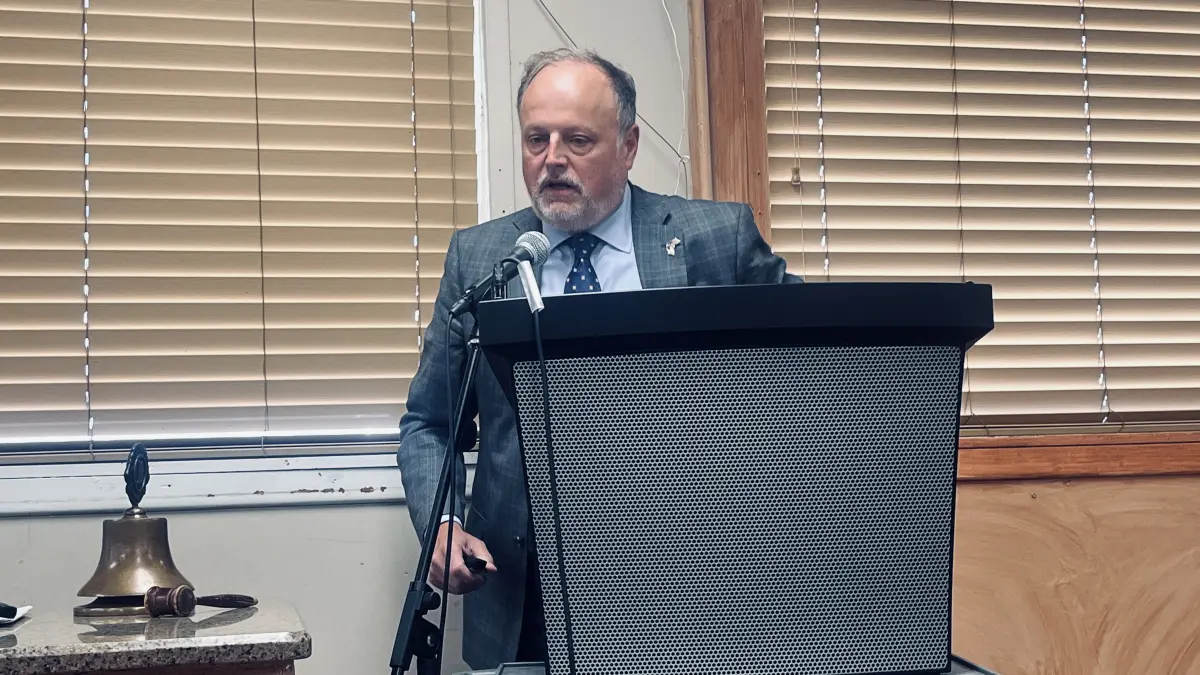
Hope attorney and Hempstead County native Jim Jackson told members of the Hope Lions Club Monday that a proposed constitutional amendment on the Nov. 3rd statewide ballot could give communities like Hope the same economic development tools already available in nearly every neighboring state, allowing local leaders to finance infrastructure improvements that encourage private investment without creating new taxes.
Jackson, who grew up in Columbus and Hope before becoming an attorney and real estate developer, used the 20-year transformation of North Little Rock's Rockwater Village to illustrate what he believes Issue Three could make possible for communities throughout Arkansas.
Introduced by longtime Lion Don Freel, Jackson noted that when the program was scheduled months ago, no one could have anticipated the announcement last Sunday that Hope Baking Company would close its Hope operation.

Reflecting that the announcement made clear the importance of economic development in the county, Jackson said he wanted to explain why he believes the proposed constitutional amendment is needed if Arkansas communities are to compete with neighboring states for housing, commercial development and redevelopment projects.
"It'll be a constitutional amendment proposal that the General Assembly has put forward. It is an economic tool that Anna Powell [President of Hempstead County Economic Development Corporation] desperately needs," he said.
He said Arkansas is one of only two states that lack redevelopment financing districts, placing communities at a disadvantage when trying to attract investment." Forty-eight states have this development tool. Arkansas does not, and it puts us at a great disadvantage when you talk about competing with our adjoining states," Jackson said.

Jackson explained that the proposal would not create a new tax. Instead, redevelopment districts would establish a baseline for property values when they are created. As property values increase because of new development, the additional tax revenue generated from property taxes generated by that growth could be used to repay bonds issued for public improvements such as streets, sidewalks, utilities and other infrastructure needed to attract private investment.
"There is not a new tax," Jackson said. "It is using what is already assessed... no new taxes. It does not affect your existing revenue."
He said the amendment would also allow growth in sales tax revenue within redevelopment districts to be used in the same way, giving communities additional flexibility to finance projects that otherwise might never get started.

To illustrate why he believes the amendment is necessary, Jackson compared Arkansas's economic development tools to outdated technology. "I found this while I was getting ready to come down. Does anybody remember what this is? It's a BlackBerry," he said. "This is like asking Anna Powell, 'You use your BlackBerry to compete with everybody else?' It's not fair... she doesn't have the right tools to compete."
Jackson said Hope could use redevelopment districts in a variety of ways to encourage investment downtown and elsewhere in the community. "It will give Anna the tools that she needs to try to encourage people to redevelop here," he said. "We can afford to put up new sidewalks. We can do the facade of the fronts of these buildings. We can have some incentives that can help somebody if they want to locate in Hope, Arkansas."

Jackson then turned to the project that shaped his views on redevelopment, explaining that he and his wife, Lisa Ferrell, began work to improve approximately 40 acres of neglected riverfront property in North Little Rock in 2005.
Before describing the project, Jackson reflected briefly on the community where he grew up. "I'm so honored to be here," he said. "I grew up in Hope. I grew up coming to the Kiwanis Club with my dad. I considered it a big honor to be invited to come here to speak to your club."
Jackson said his family's roots in Hempstead County extend back generations. He credited the Hope community with shaping his life. "Hope Arkansas made me, shaped my values, shaped my religious values, my moral values, and my moral compass," he said.

Those values, he said, eventually led him into a redevelopment effort that transformed one of the most troubled neighborhoods in central Arkansas into one of its most successful communities. "We bought 40 acres of property, the worst, most blighted, undeveloped, unwanted land in North Little Rock, and we have turned it into the best place to live in Central Arkansas," Jackson said.
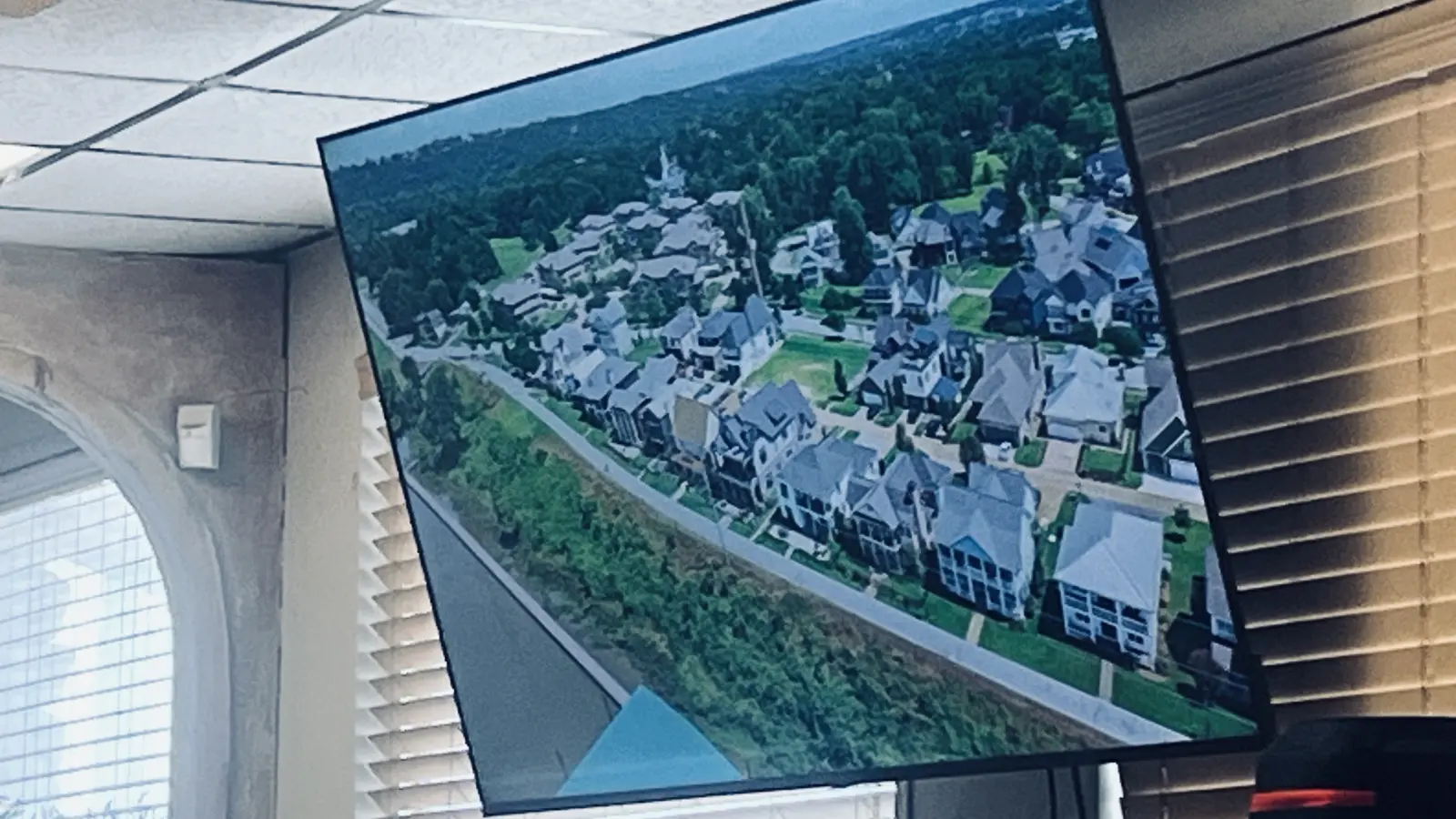
Jackson said the property his company acquired along the Arkansas River bore little resemblance to the neighborhood visitors see today. He showed photographs depicting the abandoned buildings and vacant industrial property that once dominated the area.
"The photo on the left is the property we bought," Jackson said. "That's what it looked like in 2005. On the right, with the marina and Rockwater Village on the riverfront, it is the show community of Central Arkansas."

Jackson said thee surrounding neighborhood had become a place where emergency calls and police responses consumed public resources without generating meaningful investment.
He explained that redeveloping the property required patience, substantial private investment and close cooperation from the City of North Little Rock. The project had to survive the economic collapse of 2008 before eventually gaining momentum.
A video shown during the presentation illustrated the scope of that transformation. What once generated about $54,000 annually in property taxes now produces more than $1 million each year, while more than 1,100 residences have been built in the area through more than $300 million in public and private investment.
For Jackson, however, the project's greatest reward has been watching a neighborhood become a community. "My favorite part of this process of building Rockwater Village was when we had our first Christmas candlelight luminary potluck," he said. "To come together and see families having a potluck and seeing the beautiful sharing of the food, of the stories, and the reasons of living in Rockwater Village, how much joy living in this neighborhood brings to people—that was so beautiful to me."

Jackson said Rockwater Village demonstrates what can happen when local governments have financing tools that encourage private investment while allowing infrastructure improvements to be paid for over time through increases in property values rather than new taxes.
He acknowledged that the redevelopment took two decades to reach its current stage, but said communities could shorten that timetable if Issue Three is approved. Arkansas Business ran an article on the development in its April 6-12 issue.
"Rockwater took 20 years. We're still working on it," Jackson said. "With Issue Three, with these redevelopment districts, it won't take nearly as long for a project to occur ... We can have some incentives that can help somebody with their gap in financing if they want to locate in Hope, Arkansas."

Jackson concluded by thanking the Hope community that helped shape his life and the Lions Club members for their service. "I appreciate your forefathers for helping me become the person who I am," he said. "I appreciate Anna, everything that you do, and appreciate everything you all do as Lions to give back to your community."
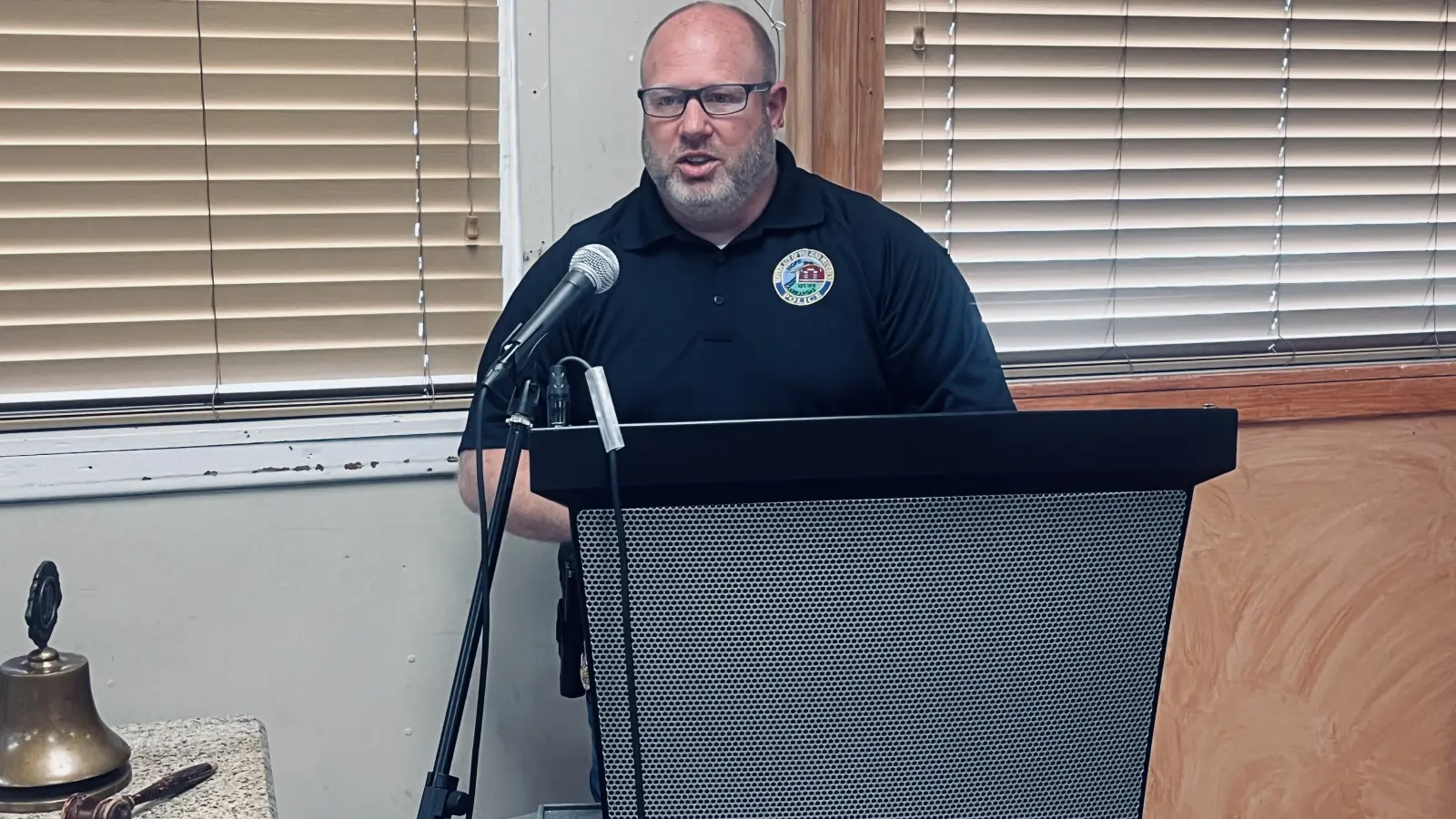
The program then turned from economic development to public safety as Hope Police Department Criminal Investigation Division Sgt. Daniel Oller discussed the work of the Eighth North Drug Task Force.
Oller, who has served with the Hope Police Department for more than 21 years and as Criminal Investigative Division sergeant for the past three, said one of the department's least understood operations is the drug task force, which was created eight years ago to focus specifically on narcotics investigations affecting Hempstead and Nevada counties.
Unlike many drug task forces that depend largely on state and federal grants and cover several counties, Oller said the local unit was intentionally created to keep its attention on problems affecting Southwest Arkansas.
"We are fully self-funded," he said. "The prosecuting attorney's office funds us. A lot of those funds come from drug seizures, whether it be forfeitures for vehicles, personal property, drug money. The busier we stay, the more funded we are."
Oller said the task force also works closely with neighboring agencies while maintaining partnerships with the FBI, Homeland Security Investigations and the Drug Enforcement Administration that allows investigators to pursue cases wherever the evidence leads.
"I'm an OCDETF [Organized Crime Drug Enforcement Task Force] officer with the FBI," he said. "I'm also a task force officer with Homeland Security. What that does is it allows me to go beyond the borders of Hope, Hempstead County. It's very beneficial to our community."
He described one investigation that lasted three years and ultimately resulted in federal indictments against five suspects: "We developed a case on five individuals that were transporting large amounts of methamphetamine from Hope, Arkansas. They were tied to a cartel in Mexico, and they're all in federal prison right now," Oller said.
Oller also recounted another investigation that led officers to seize 13 pounds of methamphetamine after a confidential informant returned from California. "When you talk about 13 pounds, you're talking about a very large-scale drug operation," he said.
He said Hope's location at the intersection of several major highways makes the city a hub for narcotics moving across the country. "The main corridors to transport narcotics run right through Hope," Oller said. "There is a lot of it that comes through here, a lot of money that comes through."

Oller said the Hope Police Department's emphasis on acting quickly on intelligence has earned investigators a reputation that often discourages drug activity before arrests are even made. "We don't send it to our desk and forget about it. We act on it," he said. "Sometimes all we would have to do is drive by their house and they would shut their whole operation down for a week. That's proactive policing."